Any business looking to get a solid foothold in the construction sector knows the value of a strong production line. When it comes to cement manufacturing, there’s a need for the right mix of machines and processes to set the pace for consistent output and streamlined operations.
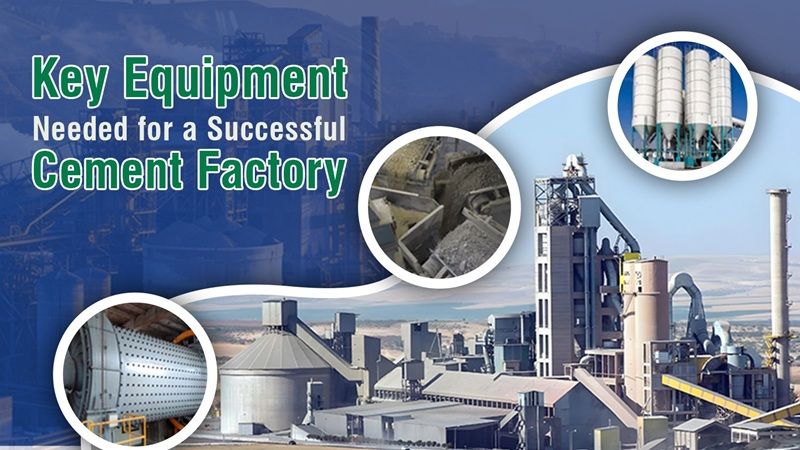
Today’s modern facilities also depend on intelligent systems to lower costs and support sustainable operations. Betterments like AI in cement manufacturing and automation in cement production help track plant performance and spot issues before they escalate.
Therefore, selecting cement plant equipment that supports both productivity and eco-friendliness becomes necessary for businesses to keep pace with global demands.
Below, we’ll find different equipment that will be used to set up a successful cement factory.
Understanding the Cement Production Process
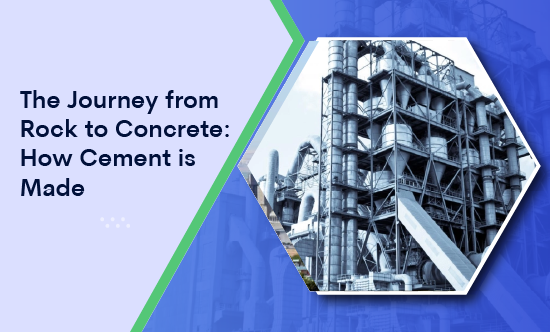
The cement manufacturing process involves multiple stages before it is packed and bagged for shipping. The below image represents each major step in the process.
Let us now understand each step briefly.
Raw Material Extraction (Limestone Quarry): Large deposits of limestone, the primary raw material for cement, are excavated using heavy machinery like excavators.
Transportation to Crusher: Dump trucks transport the limestone from the quarry to the primary crusher.
Crushing & Grinding: The limestone rocks pass through a crusher, reducing them into smaller pieces. Also, a secondary crusher further refines the size of the limestone and other additives like clay and sand.
Proportioning & Mixing: The crushed materials are sent to proportioning equipment, where the correct blend of limestone, clay, and sand is prepared.
Preheating & Precalcination: The raw mix moves into the preheater tower. Hot gases from the kiln heat the material before it enters the kiln to remove moisture and initiate chemical reactions.
Clinker Production (Kiln Process)
The rotary kiln is where the raw mix is heated to extremely high temperatures (~1400°C), forming small, greyish-black nodules known as clinker. The heat is partially recycled to improve energy efficiency.
Clinker Cooling
The clinker cooler rapidly cools down the clinker using air, making it ready for grinding.
Cement Grinding: The cooled clinker is mixed with gypsum and sent to the grinding mill, which finely grinds it into cement powder.
Final Proportioning & Quality Control: The ground cement undergoes further refining in the finish grinding mill, ensuring uniformity and strength.
Storage in Cement Silos: The finished cement is stored in cement silos, ready for dispatch.
Packaging & Shipping: The cement is packed into bags using cement packaging machines or loaded in bulk into trucks to be shipped to various destinations for construction projects.
Essential Equipment for Cement Manufacturing
The selection of cement plant and factory equipment must consider the characteristics of raw materials, capacity targets, and sustainability goals. You’ll need to know the right cement plant equipment and check out the top features to look for in cement manufacturing equipment if you are interested in how cement is made in the factory.
Let’s further analyze the core machinery, their roles, and the ways they shape modern cement facilities.
Raw Material Extraction & Processing
It all begins with the raw material, limestone being the primary one, accompanied by additives such as clay or shale.
This stage involves pulling limestone, clay, and other minerals from the ground and preparing them for the kiln.
You’ll use the following types of equipment here.
Quarrying Equipment
Excavators remove large chunks of limestone and clay from quarries, while loaders transfer these materials to transport systems. Drills are also used when rock faces need to be blasted or fragmented for simpler handling.
Crushers
After extraction, raw materials move to crushers that break them down into manageable sizes. Each type of crusher supports a different capacity range and hardness profile, so the decision depends on the plant’s scale and raw material properties.
Different sorts of crushers are used here.
- A jaw crusher subjects big stones to compressive force.
- A gyratory crusher can process high volumes and handle abrasive rock.
- Impact crusher flings materials against hard surfaces and breaks them down into smaller pieces.
Raw Mills
Once large chunks are reduced, the mix heads to a raw mill in cement plant operations. Below are the common raw mills:
- Ball mills: They contain rotating steel balls that grind materials into a homogenous powder.
- Vertical roller mills (VRM): Often paired with ball mills for cement when aiming for smaller footprints or lower power usage.
Clinker Production (Kiln Phase)
Producing clinker can turn ground raw material into clinker that involves intense heat and precise chemistry. This core step requires cement factory equipment to withstand high temperatures while maintaining steady throughput.
Key elements include :
- Preheaters & Precaciners: Raw materials pass through tall towers before entering the kiln. Designs involve the use of either cyclone technology or a range of suspension features.
A precalciner is installed to speed up decarbonation to shorten the time needed in the kiln and supports energy efficiency in cement plants.
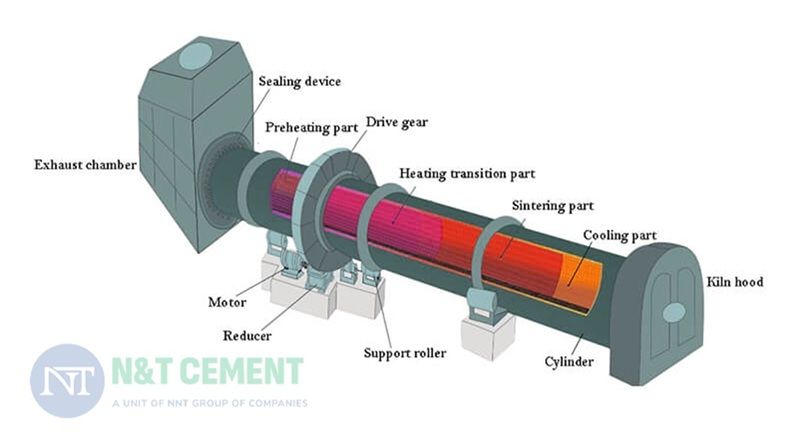
- Rotary Kiln: The kiln forms the center of a cement manufacturing process. This rotary kiln is a slightly inclined cylinder that rotates slowly.
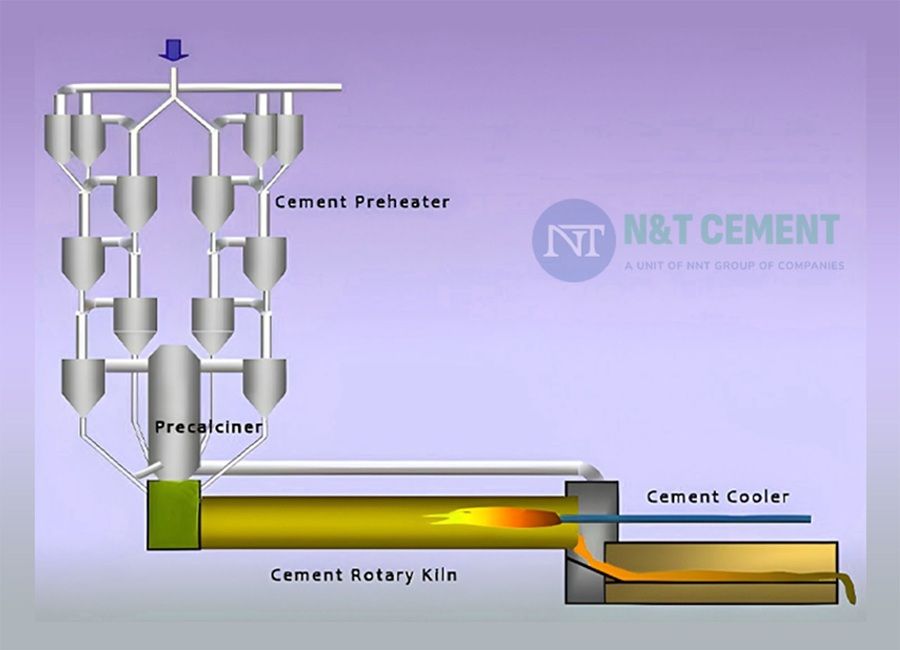
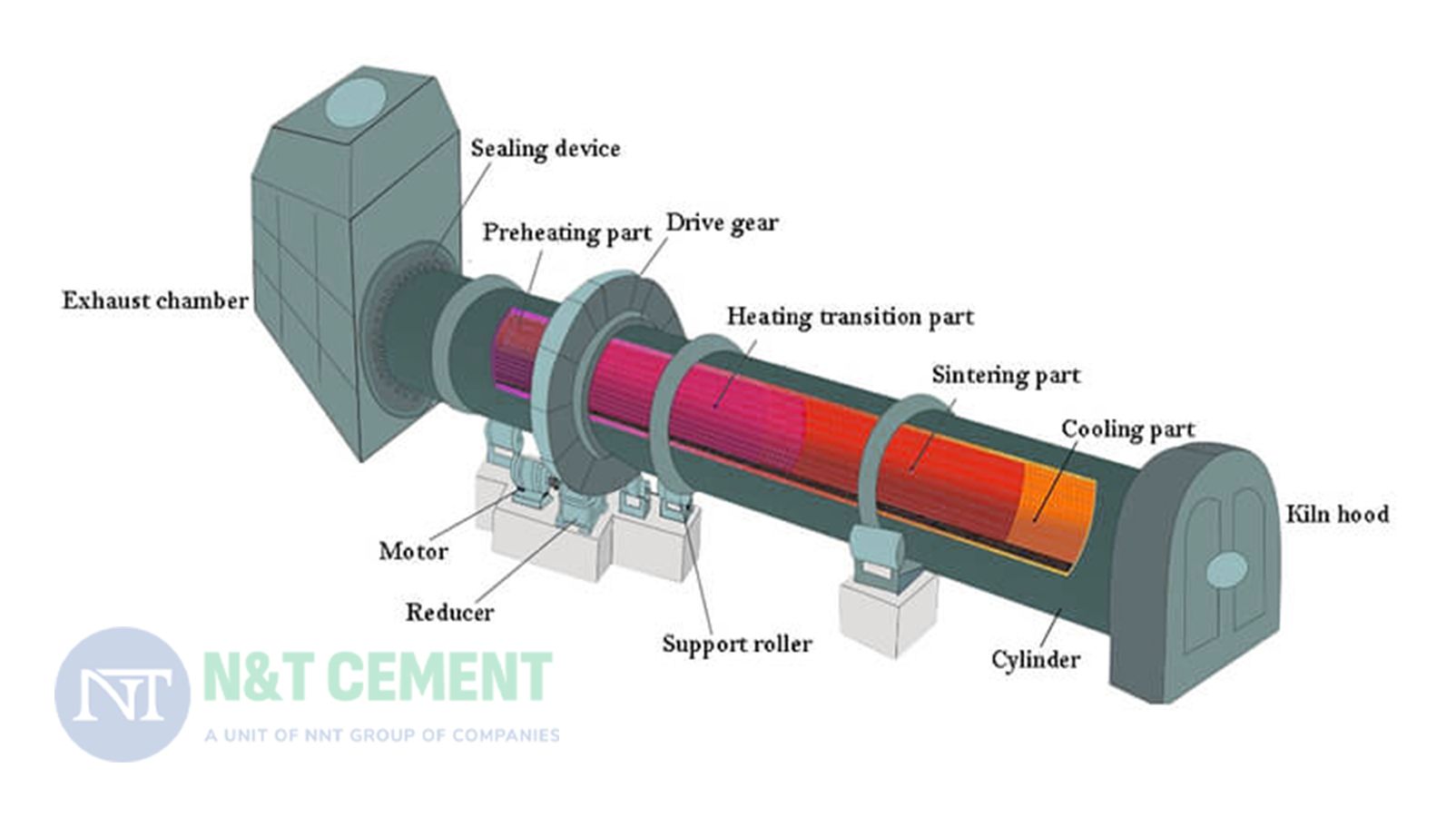
The mix enters from one end, and as it moves along, high temperatures prompt the clinker production process. Most kilns reach up to 1,450°C, leading to chemical changes that give clinker its distinct properties.
- Clinker Coolers: Grate coolers use a perforated bed and forced air, while rotary coolers rotate clinker inside a cylindrical shell.
Both configurations bring the temperature down and conserve energy.
Cement Grinding & Storage
An efficient grinding system prevents lumps and supports predictable performance in the field. Those interested in different final compositions can look at Types of Cement and the way additives influence characteristics.
- Clinker Grinding Units: Grinding setups often feature either a ball mill or a VRM, with distinct traits for each approach.
Below is a table comparing some key differences:
| Aspect | Ball Mill | VRM |
|---|---|---|
| Grinding Action | Rotating steel balls | Rollers over a rotating table |
| Power Draw | Tends to be higher | Usually lower |
| Particle Uniformity | Can vary somewhat | More uniform |
| Maintenance | Straightforward but frequent | Specialized, less frequent |
| Footprint | Often larger | Generally more compact |
A cement grinding must handle consistent feed rates and maintain uniform outputs. A VRM is helpful for plants looking to reduce power usage or space needs.
- Cement Silos: After grinding, the finished blend moves to cement silo storage which are tall bins. They preserve quality by shielding the powder from moisture and contaminants while keeping dust levels down, which is necessary for both safety and product purity.
Packaging & Dispatch
Finally, you’ll need cement bagging and packing solutions that focus on cleanliness and speed. These solutions ensure that the product leaves the facility in prime condition.
- Packing Machines: A cement packaging machine may feature either rotary or inline packers. Rotary packers use a rotating platform to fill multiple bags simultaneously, while inline machines move bags along a straight conveyor.
- Conveyors & Loading Systems: Moving the cement from silos to trucks or railcars requires dependable conveyor lines. Belt conveyors handle large flows without spillage, keeping the area tidy. Also, pneumatic systems are another option, especially when the goal is to move fine powders quickly.
Pollution Control & Energy Efficiency
Modern operations prioritize plant cleanliness and resource conservation. Cement factory equipment that is focused on dust management and low-carbon measures can shape a facility’s overall success.
- Bag filters and electrostatic precipitators (ESPs): This helps trap airborne particles. Bag filters rely on fabric membranes to capture dust, while ESPs charge particles so they adhere to plates.
Both designs lower pollution levels and protect the health of workers and local communities. Dust collection systems for cement plants can also cut product losses and keep the environment safer.
- Waste Heat Recovery Systems (WHRS) for Power Generation: Gases leaving the kiln and cooler still contain thermal energy. Systems that capture this heat and channel it into turbines produce power, reducing reliance on external electricity and trimming running costs.
Also, these steps add to the overall goal of cutting carbon footprints. Many experts see such setups as a core part of energy efficiency in cement plants.
Automation & Digitalization
High demands push facilities to adopt tech-driven methods. There are innovations like real-time data tracking, cement plant automation, and other digital systems that you can consider using in this system.
One route involves AI in cement manufacturing and sensor-based monitoring that offers insight into production flows.
- Supervisory Control and Data Acquisition(SCADA), IoT, and AI-driven Predictive Maintenance: Another group of technologies that command centers gather data on temperature, vibration, and pressure at multiple points. These figures are displayed in user-friendly dashboards, allowing quick responses.
Also, Internet of Things (IoT) devices transmit data around the clock so that the operators can see patterns or unexpected spikes in real time. AI modules may also adjust feed rates or fuel mixtures, raising overall consistency.
- Smart Sensors & Digital Control Systems: Sensor kits on kilns, mills, and conveyors gather detailed operational data. Pair it with advanced software does help these readings to refine cement manufacturing processes.
Some facilities even lean on automation in cement production for tasks like raw material blending or bagging.
Challenges & Solutions in Cement Plant Equipment
Machinery in this field must handle intense loads, abrasive materials, and soaring temperatures. Failures can disrupt schedules and drain budgets.
Expansion plans for cement manufacturing will cause managers to review cement factory setup costs or weigh new acquisitions from cement industry machinery suppliers.
Common operational challenges
Below are the major bottlenecks and the methods to address them.
- High energy consumption: Fuels and electricity represent a significant portion of expenses.
- Wear & tear: Constant grinding and high heat degrade parts quickly
- Emissions: Regulatory bodies clamp down on dust, CO₂, and NOx levels.
- Equipment downtime & failures: Unplanned halts interrupt shipments and reduce revenue
- Rising operational costs: Labor, utilities, and raw materials can strain overall budgets.
Solutions
Let’s find a few possible solutions that are helpful in running a successful cement factory.
- Upgrading to energy-efficient cement plant equipment: Swapping older sections for newer cement production machinery can reduce overall energy draw. It includes advanced mills, improved kilns, or fans with variable-speed drives.
- Regular maintenance: A structured schedule helps keep gear in good condition. Check the wear components and lubricants on a set timeline to limit failures.
- Advanced Dust Collection & Emission Control: Filters and ESPs keep particulate levels in check, while low-NOx burners address gas emissions. This step lines up with local guidelines and helps protect staff health.
- Automation & Smart Monitoring: Systems with real-time data give alerts before issues grow critical. This suits high-throughput plants that can’t afford unplanned halts.
- Optimizing Operations & Cost Efficiency: Production teams assess process data to find areas of improvement. Even minor adjustments to feed or burner settings might lead to sizable gains in output.
Future Trends in Cement Plant Equipment
Producers aim for gear that cuts emissions and meets shifting demand without harming margins. Data from Global Cement Market Growth reveals a continuous climb in worldwide consumption, prompting factories to look at higher capacity lines.
New paths also involve decarbonization strategies and the use of alternative fuels for cement kilns.
Below are a few trends to watch out for in the cement manufacturing industry.
AI & Robotics in Cement Production
One of the top trends for the construction industry in 2024-2025 is geared at AI & Robotics in cement production. It is automated vehicles and sensor-equipped machines handling key tasks.
Systems that track material flow, temperature ranges, or mechanical stress make it simpler to predict failures and schedule part replacements.
These tools also respond to subtle changes in raw materials, reducing waste and enhancing overall control. Some plants deploy robots to tackle heavy or repetitive jobs, which eases the staff strain and keeps operations safer.
Use of alternative fuels & sustainable materials
There is also growing interest in alternative fuels and sustainable materials. Many facilities are exploring using biomass or industrial by-products as fuel to reduce their reliance on traditional sources.
Such decisions trim carbon footprints and resonate with global calls to protect resources. Research in new clinker blends is on the rise, pointing to reduced emissions during processing. This approach appears in specific projects focused on green construction themes.
Advances in carbon capture technology
Specialized units pull CO₂ from kiln exhaust or cooler vents before it reaches the atmosphere. Some pilot programs even inject captured gas into other products, allowing fresh ways of handling emissions.
While the details may be different, this approach signals a plan to address global concerns. As producers adapt to evolving standards, next-generation equipment may define tomorrow’s way of making cement.
Conclusion
Each machine, whether it’s a raw mill or a cement packaging machine, influences product consistency and operational costs. Planning can smooth out hiccups and keep production lines on track, especially as new technologies appear.
Those still comparing vendors or mulling over expansions may want to check our tips on how to choose the best cement plant manufacturer for your needs.
Ultimately, you’ll discover why our cement plant solutions are the best investment for your business.